Why would I buy a hearing aid?
〰️
Why would I buy a hearing aid? 〰️
How do we determine how likely a hearing loss patient is to consider purchasing a hearing aid?
In July 2026 I was tasked with a very interesting feature: determining a way to measure how likely the conversion of current Soundservice hearing aid retailer leads are.
The question underneath this is a more interesting one.
How do the hearing specialists know when a person with hearing loss is likely to become a customer?
UI/UX
2026
Figma & Adobe Photoshop

How do I make a system that explains to me whether someone is a good candidate for being fitted with a hearing aid?
There are many questions that we could continue asking about the client itself. For example I could wonder about their behavior around our phone calls: whether they routinely decline to speak with the receptionist or whether they are difficult to reach for their next check-up.
I could go further and think about whether they have ever returned the hearing aid because of difficulty of use.
Which data do I need? Financial? Do I go looking for reports?
Better yet? Should I prioritize leads that are more likely to convert? If yes, I will need to devise a way that helps me decide that priority.
Problems to determine
-
A star based system?
One of the stakeholders has proposed a stars based review system that allows us to rate patients by their likelihood of conversion. Thus we could have 1 star, 2 star, 3 star patients and know exactly who to seek out first.
-
Do we already have the data?
Are our users already writing down the information by which they often know how likely a sale is to be made? If yes, how do i find it in our system? I already had a guess: manually written down ‘patient observation' notes in the CRM.
-
How do I actually address the underlying issues that prevent sales?
I don’t.
But my users do. I just need to help them identify, remember and keep track of those issues.
I need to help my users take actionable steps to help patients. I need to help their decision making.
How do my users perceive patients? I interviewed them ‘indirectly.’ I spent my afternoon reviewing hundreds of observations to understand which behavioral patterns specialists repeatedly documented.
Research insights


Financial Readiness
Price influences timing more than interest. A lot of delays occur.
Emotional Readiness
Some patients are resistant because they do not believe hearing aids will improve their lives.
9860+
Patient Entries
3,685
Real Patient
Observations

Stigma
Appearance and embarrassment appeared repeatedly.
Family Influence
Partners frequently influence purchasing decisions.
I expected specialists to document medical facts. Instead, I found that many observations described human behavior.
Hearing specialists repeatedly wrote about hesitation, family influence, financial concerns, emotional acceptance, and motivation. These behavioral signals often explained why a patient progressed or stalled far better than clinical data alone.
That insight became the foundation for a structured assessment that transformed subjective observations into reusable CRM data.
Is this patient psychologically ready to move forward?
Did the patient ask many questions? Were they curious? Or perhaps passive and didn’t engage much? Did they feel rushed? Angry? Confused?
Can they realistically purchase?
Concerned about prices? Do they know about financing options? What is their budget?
Do they believe treatment is worth it?
Do they realize whether or not hearing loss is affecting their day to day quality of life? Do they trust us? Do they trust the devices?
How do you capture expert intuition without making people write another paragraph after every consultation?
Does this patient need hearing aids?
Is their audiogram done? Hearing loss confirmed? Trial of a hearing aid performed?
Have they accepted hearing loss and hearing aids?
Are they embarrassed? Do they accept hearing loss? Do they want to wear hearing aids?
Design Principles
While gathering the data I realized why a star based review system was not fitting the scope of my project. I needed to get to know people, not express how preferences exceeded or failed my expectations.
Solution. I needed something that gets my users in the state of mind that is more empathic.
Capture intuition in under 30 seconds
Encourage empathy rather than judgement
Preserve nuance
Reduce typing
Create reusable data
Emojis.
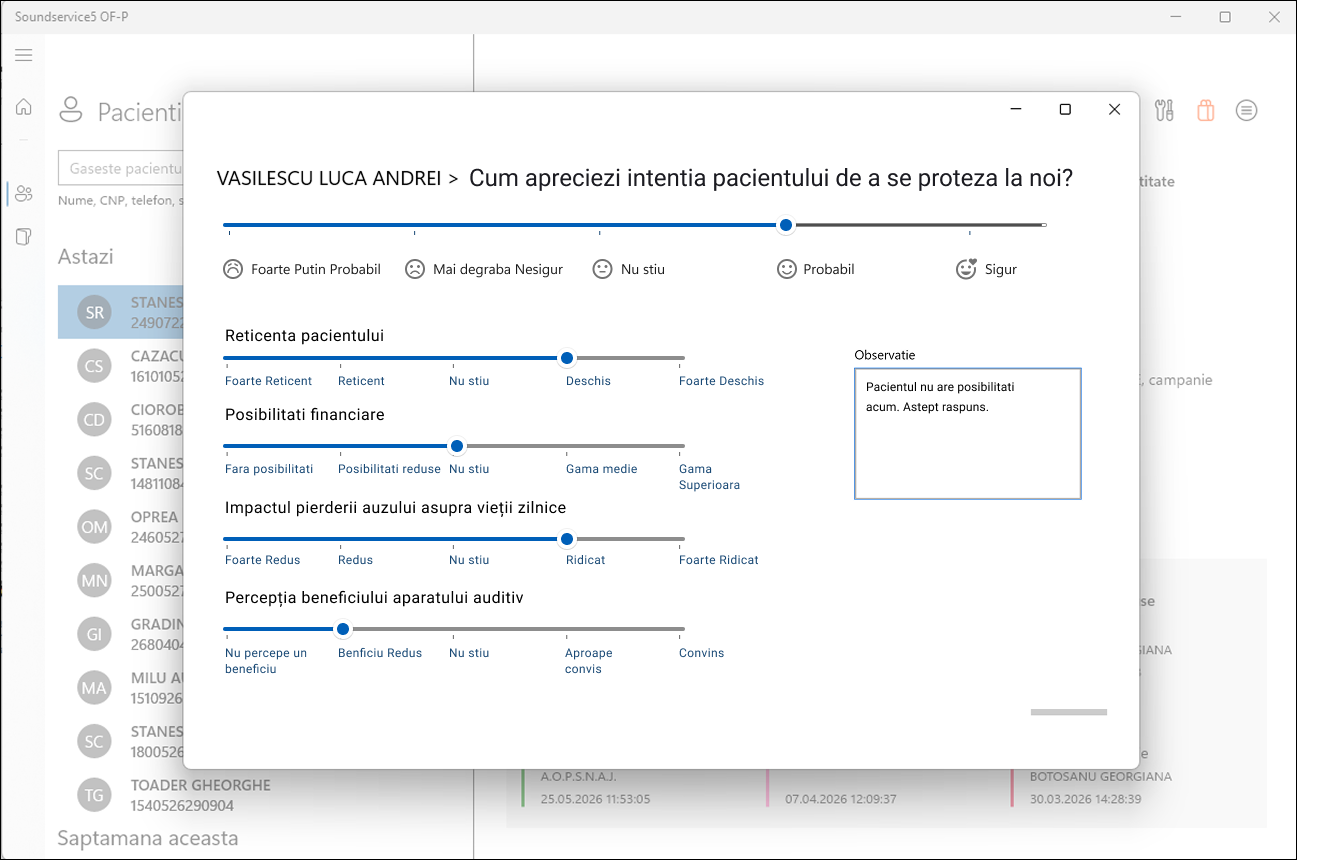
The feature is integrated into the company’s CRM solution.
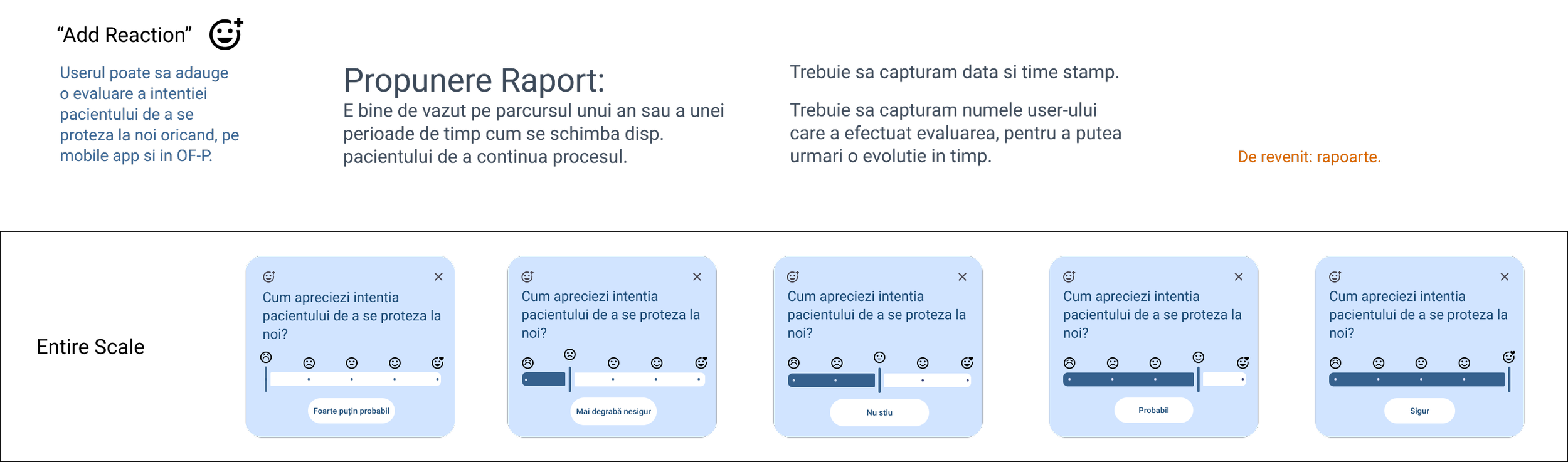
After a patient leaves the hearing aid center, the hearing specialists clicks on the icon pertaining to this feature, quickly goes through a general ‘vibes’ slider that relates directly to how they felt the attitude of the person sitting across from them.
Then we get into specifics.
And each criteria can directly indicate actionable steps for the future.
Example. I, the user, realize my patient perceives that the benefit of owning a hearing aid is not that great even if medically…i have an advanced hearing loss level. That means that next time I interact with my patient I should perhaps discuss this matter with them.
Slide away!
Each interaction with a patient gives us the opportunity, as users, to make a sale…. Or change their mind in regards to getting closer to a sale when the goods and services we are offering are outside their comfort zone, impulsiveness and especially when they pertain to a medical issue.
I ask my users:
How likely do you think it is that your patient would like to get fitted for a hearing aid with us?
They have a few seconds to reply:
😠Unlikely
☹️Less likely
😑I don’t know
🙂Likely!
🥰 Certainly!
The video showcases the user workflow in the CRM module of Soundservice related to filling in the form I have designed.
Build for efficient cues
In the read only version of the filled in form, the tags are color coded. Orange for ‘these are the subjects we gotta work on!’
Or
Blue for ‘we already know this criteria is being met. Check!’
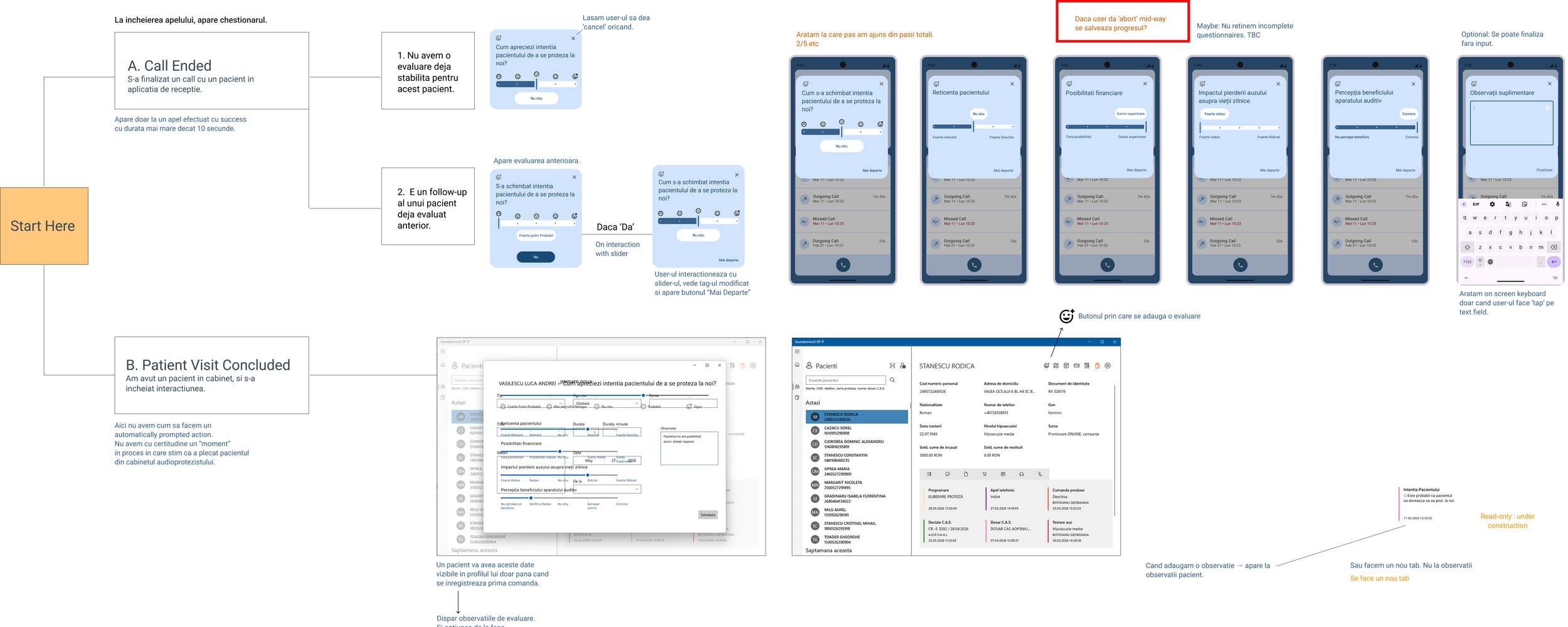
I had designed mobile first. Soundservice has a mobile app for receptionists that use it to keep track of phone calls towards clients and patients. A phone call is also an interaction where the observed behavior may change. Thus, after each call ends…my users receive the fillable form. Same sliders.
And the opportunity to add a new observation manually. Because the details are important to the entire process.
Feedback
A couple weeks of testing after, I received my first user feedback for this feature.
Early impact
🥰Implemented into the CRM workflow.
🙏Validated with hearing specialists across multiple centers.
👍Created reusable structured data from previously unstructured observations.
🎉Enabled future reporting and follow-up automation.
Future Features
Next up is
Scheduling Reminders via the mobile app for phone calls.
Allows users to double down on the issues determined by the form evaluation I have built or to simply keep in contact with the patients and clients for various reasons. Establish communication, gather feedback, call them back for a check-up. Anything.